


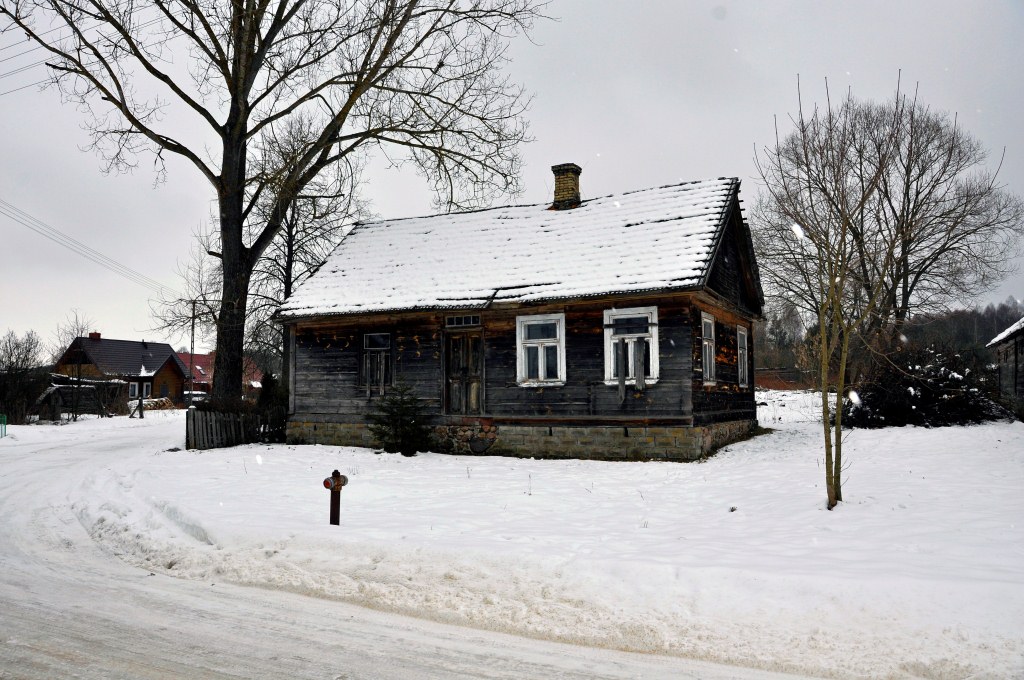
Do you sometimes wish you could get away from alarm clocks, ringing telephones, e-mails and all that stuff? Is it even possible?… We managed to find a great place to unwind during last weekend. The place is called Kruszyniany and it’s a small town situated near Puszcza Knyszyńska, 50 km from Białystok and 3 km from the border with Belarus. No cell phone signal at least for Orange network. Now you know who will be able to really forget about the everyday life there 🙂

picturesque Podlasie
We almost got stuck in the middle of the forest when our car got buried in the snow. Fortunately with the help of our friends and the hosts as well, we were freed and managed to get where we were supposed to get – to Kruszyniany…

winter is doing pretty well
Kruszyniany is a tiny village which is easy to pass through without noticing. There are three Tatar families living there, four more can be found in nearby Bohoniki. Both villages are partly hidden from the world and perfect for a weekend with no connections to everyday life.

mosque in Bohoniki
We stayed in Tatarska Jurta in Kruszyniany run by a Tatar lady Dżenneta Bogdanowicz and her family. We came upon the Bogdanowicz family after reading an article about them on one of the website. They seem to have very modern approach and were featured in numerous travel and women magazines. They are known for promoting Tatar cuisine, customs and history. Hail to them for promoting marvellous and exotic Tatar customs that nobody expects to find 250 km from Warsaw.
In Kruszyniany they will provide you with their own delicacies – both sweet and spicy – a delicious breakfast (I still dream about scrambled eggs with cottage cheese and plum marmalade!), interesting stories and a helping hand (even if this means digging your car out of snow on a Friday evening…)

Listkowiec – a yeast cake with cottage cheese served hot; this cake has won many prizes
A night at Tatarska Jurta costs PLN 65, breakfast included. The rooms are nice and clean, furnished with wood and with bathrooms. The breakfast is big and tasty. This time we went there in an adult group, but it’s a family friendly place and you can stay there with children as well. The owners have their own little 2-year-old and all the necessary stuff – high chairs, toys, little bikes and books. Maks is coming here with us in the summer. And as he is quite easy-going, the little Tatar – Emir – will quickly become his friend 🙂

a Saturday walk
There’s a mosque in Kruszyniany that’s worth seeing. Dżemil Gembicki, the local guide, will show you around. He’s a good speaker and his stories about Tatar customs are both interesting and funny. In Bohoniki, Eugenia Radkiewicz will quickly check your ability to memorise facts and figures, so if you’re not into tests, choose Dżemil in Kruszyniany 🙂

mosque in Kruszyniany
Tatars from all over Poland (not only from nearby cities of Supraśl and Białystok, but also from further destinations such as Gdańsk or Wrocław) come to mosques in Kruszyniany and Bohoniki for their religious holidays. There’s approx. 5,000 Tatars, or Poles of Tatar origin as they like to call themselves, in Poland. Kruszyniany and Bohoniki are the only Muslim communities in Poland with mosques and old cemeteries called mizars.
As we learned from Dżemil, Tatars have been living in the Białystok region for the last six centuries. They came to Poland from Crimea, Asia and from the area of Nowogródek (Navahrudak) that was then a Lithuanian city.
Dozens of Tatar people were killed during World War I. Many villages, cemeteries and mosques were destroyed or lost their Tatar characteristics. After World War II from as much as 6,000 Tatars living in Poland before the war, only 2,000 were left. Communities were established in Gorzów Wielkopolski, Gdańsk and Białystok. Today Białystok has the biggest Tatar population in Poland the therefore is the biggest Muslim centre in the country.

interior of the mosque in Bohoniki

interior of the mosque in Kruszyniany
Both mosques are quite small, wooden, colourful and a bit… magical. They are built in accordance with Muslim rules with separate rooms for men and women, so that they don’t distract each other during prayers. During winter it seems to be colder in the mosque than it is outside. Even colourful carpets don’t make your feet feel any warmer. The shoes need to be placed in the corridor, as in every mosque. It’s not a problem in May, but in February it might distract you a little bit. Remember to take some warm socks with you!
Behind the mosque in Kruszyniany, there’s also a mizar – a Tatar cemetery.

the oldest graves
You can find older and newer graves there, with some dating back to 19th century and decorated with Arabic symbols and the crescent. The old ones consist of two stones – a bigger one placed where the head lies and a small one in the feet area. Walking around the graves you will notice typical Tatar names such as Połtorzycki, Popławski, Aleksandrowicz, Bogdanowicz…

and the newer ones…

unsusal cemetery at the world’s end
It’s a common tendency now, even for young Tatars, to get back to their roots and traditional customs. After migrating to big cities in the 1990s, now they are coming back to their native lands and keep the tradition alive.
Even though they changed their language, assimilated and in most cases treat themselves as Poles with Tatar origin, they still keep their tradition, religion and cuisine alive. The latter interested us most 🙂

traditional and extremely time-consuming pierekaczewnik
The best place to try Tatar food is Tatarska Jurta. The walls are covered in various certificates legitimising culinary skills of the host and her family. We know that the hosts got numerous prizes for babka ziemniaczana, pierekaczewnik and listkowiec. We also know, that we HAVE to eat them all. Pierekaczewnik, which is a type of layered pastry with meat, onion and butter, is certified Guaranteed Tradition Specialty and protected by the EU. There’s only one certificate allowing the production of this specialty and it belongs to Ms. Dżenneta.
Apart from pierekaczewnik, we tried other local treats such as: belysz, kryszonka, dumplings with meat, kartoflaniki, manty, listkowiec… These names probably don’t ring a bell but don’t worry, there’s a short guide coming tomorrow 🙂 I’m sure it will encourage you to take the trip as much as the picturesque mosques or even more!

where the devil says goodnight…

0 Comments