


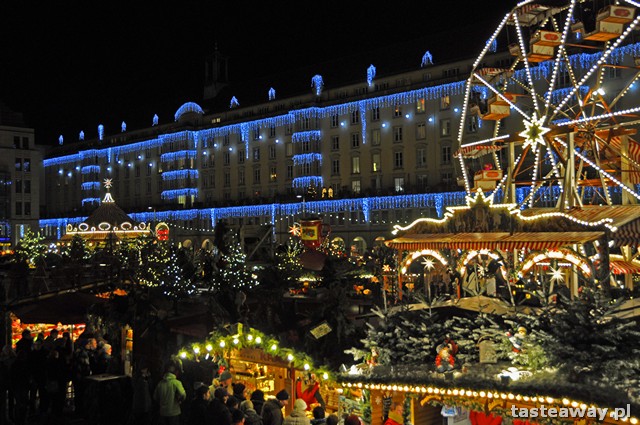
Christmas… to be honest, I don’t know many people who don’t like it and remain unmoved by its magic that has started to be visible in the streets a few weeks ago. OF course, sometimes we get annoyed with buying presents in crowded shopping centres and with shops that put up Christmas decorations and offers already in October, but in December we love these decorations, the presents, Christmas gift sets and all these lights in the streets. And if you add snow, falling slowly from the sky… it’s just pure magic!
For quite a while we’d been thinking that Christmas markets in Germany must be one of the best places in the world to feel the magic of this special winter moment. When it turned out that the German National Tourist Board (DZT) thought the same and helped us organise our trip during which we will discover everything about the tradition of these Christmas fairs, we started jumping for joy! Colourful, shining with millions of lights, with all sorts of lovely decorations and marvellous figures, with lots of presents, ornaments and everything you can possibly buy on those markets. And all this accompanied with the scent of mulled wine (gluhwein) and German sausages (bratwurst), served with a white roll, fried potatoes or as currywurst, with a sauce similar to ketchup, and sprinkled with curry. We already had a chance to try these specialties during Oktoberfest, and that’s why it was also our first meal in Dresden, where we started our Christmas adventure 🙂

- the most famous: Dresdner Striezelmarkt
So let’s start our trip with Striezelmarkt in Dresden.
Striezelmarkt is the oldest Christmas market in Germany — it was first organised in 1434! Back then, the market took place right after the fast and sold mainly meat, which was later prepared and served in Christmas meals. Later, markets started offering also cakes such as traditional stollen, also called striezel, from which the Dresden market took its name. Stollen is quite a heavy yeast cake with dried fruit and raisins, prepared a few weeks before Christmas Day and then left so that it gains proper texture and flavour. Finished cake is covered with melted butter and sprinkled with icing sugar. Traditionally, the cake was rolled up, which was supposed to resemble covering up baby Jesus in his clothes. Still today there are families that follow this traditional recipe and start preparing stollen long before the first snow. Unfortunately, so far we haven’t had a chance to try stollen but we’re planning to do it soon! 🙂 We didn’t manage to get to Dresden on 7th December when 20th Stollen Festival (Dresdner Stollen) took place. During the festival the royal baker and stollen maiden cut the giant cake into pieces and give it to all the guests. Maybe you’ll have a chance to see it live next year?
On Christmas fairs you’ll find wonderful wooden handicraft, Froebel stars, lights, various figures of Santa, snowmen and everything you can think of related to Christmas. And the things are so beautifully made you really want to buy them all!

- eye-catching stalls

- what would you like for Christmas?

- Christmas is coming!
Striezelmarkt on Altmarkt Square is the biggest and the most traditional of all the Dresden Christmas markets, but this year we have as many as 11 of them here! Our guide told us that nowadays a lot of districts organise their own, smaller markets. In other words you can just walk around the city from one market to another sipping mulled wine, eating bratwursts and other delicacies such as hot waffles, rolls or fruit on a stick covered with chocolate. Everyone will find something for themselves!
We visited also much smaller but very picturesque markets near Frauenkirche and a very romantic market near the castle. We didn’t have time to see them all, but you should definitely do so if you’re in Dresden for 2-3 days!
What also amazes us here is the attention to detail — most of the stalls are very Christmasy and you can see that both the decorations and the vendors look very traditional, almost like in the old times. This is yet anther thing that makes you feel like in a Christmas fairy-tale here!
I don’t think I have to tell you that Christmas markets are a perfect place for kids, too? All children will find these places full of beautiful figures, lights and colours truly amazing. Maks, who was a bit tired after a long journey from Warsaw, liked bratwurst and the Nativity Scene in Neumarkt most. While watching the latter, where a couple of sheep live now, we also had the funniest moment of our trip: when Maks saw one sheep poohing in front of a large number of visitors, he said: ‘You should only do that in the toilet, you know sheep?’. As you can see even in the very clean land of the Germans there’s always someone you can teach how to be clean 😉

- tasty and fairy-tale-like stalls – Neumarkt, near Frauenkirche

- would you fancy some mulled wine?

- Maks recommends: the Nativity scene
When you’re in Dresden, it’s really worth to leave the very centre and see a bit of the city. Even a short stroll will give you a chance to visit Frauenkirche church, Brühl’s Terrace, Dresden Castle and Semperoper building.
We set off from our hotel in Neumarkt and began sightseeing from Frauenkirche (Church of Our Lady). With its gigantic dome, the church is one of the symbols of Dresden and one of the most famous monuments of the Protestant sacred architecture in Europe. It was originally built between the years 1726 – 1743, but then completely damaged during the bombardment of Dresden in 1945 — the only part that was left was a remain of one of the walls. Today, it’s easy to tell which part of the building is old and which was rebuilt using sandstone. Ruins of the old church were standing in the city for very long as Frauenkirche was recreated only in the years 1994 – 2005. Interestingly, the whole amount needed for the reconstruction of the church (EUR 180 million) was collected in the form of private donations. Today, this church with a beautiful sculpted altar, proudly dominates over the Old and New Town.

- Impressive Frauenkirche
Another great place for a walk is definitely the promenade on the shore of the river Elbe, called Brühl’s Terrace. Its was named after the Count Heinrich von Brühl, who in the years 1738 – 1763 almost governed the Saxon land when the king Augustus III was busy devoting himself to art and opera. What is now Brühl’s Terrace used to be the Count’s palace, where a library could be found with more than 62,000 book! Unfortunately, all this — just like most of the city of Dresden — was destroyed in 1945. Today, you can find the Academy of Fine Arts there, as well as a place with spectacular views of the river Elbe and Augustus Bridge.

- Bruhl’s Terrace

- Beautiful views at night
From the Terrace we went on to see the Dresden Castle, the Semperoper building and Zwinger Palace complex.

- Dresden Castle with its neo-renaissance facade

- for tired wanderers and for kids 🙂

- Semperoper (Saxon State Opera) — 91% attendance and one of the world’s best orchestras

- Zwinger — one of the most famous Baroque buildings in Europe
An afternoon or evening walk around Dresden finished with a snack at Striezelmarkt is a great idea for a nice Saturday or Sunday. We would love to stay here longer but today we’re moving on to see Nuremberg that (I hope!) will amaze us all with its Christmas atmosphere!
In the meantime we really recommend visiting Dresden — there are still two weekends left till Christmas! 🙂 It is quite a journey from Warsaw (700 km), but on the other hand the roads are very good (highways all the time — for Poznań and then for Berlin). It’s much closer from Poznań and Wrocław, so what are you waiting for there?? Come and visit! Have some gluhwein, sweet stollen and bratwursts and get ready for Christmas! 🙂
PRACTICAL INFO:
If you wish to go sightseeing in Dresden, learn about its history, about king Augustus II the Strong, the Countess of Cosel and the Anti-Sobriety (!!!) Association, we can recommend a wonderful guide that led us through the streets of Dresden: Ms Kornelia Böttrich. You can contact her at kornelia-boettrich@web.de or give her a call on 0049 178/3411431. And don’t let her name mislead you (like it did with me :)) Ms Böttrich speaks perfect Polish and the way she tells all the stories really make you travel in time, for instance to the 30-day-long wedding celebrations of the king Augustus III.
* this post was written in cooperation with the German National Tourist Board (DZT)

0 Comments